
What Blaine County Deed Records Reveal
The Recorder indexes more than deeds. Mortgages, liens, plats, surveys, releases, and other statutory instruments sit in the same Blaine County index. A deed identifies the transfer and carries the legal description, while related instruments can shape use or claims without moving ownership at all.
| Deed Type | What It Does | Common Use |
|---|---|---|
| Warranty deed | Conveys the stated interest with covenants in the instrument | Conventional conveyance |
| Quitclaim deed | Conveys the grantor's stated interest without promising its extent | Family or title cleanup transfer |
| Trustee deed | Records a conveyance made by a trustee | Trust administration or trustee sale |
| Personal-representative deed | Records an estate representative's conveyance | Probate administration |
| Tax deed | Records a tax-related conveyance | Completed tax process |
A mortgage is not a deed. Neither is a lien, notice, or release. Search those related records to understand the parcel, but pull the image and any later satisfaction before calling an encumbrance active.
Inside the Blaine County Tyler Deed Search
The Tyler Recorded Document search does more than name matching. Grantor and Grantee get separate fields, plus Either Party. A recording-date range, Document Type, Instrument Number, Book, Page, Parcel Number, Subdivision, Lot, Block, Tract, Unit, Section, Township, Range, Notes, and Advanced Name Searching round out the search options.
| Party query | Grantor, Grantee, Either Party, company/last name, first and middle name |
|---|---|
| Record query | Instrument number, book/page, document type, recording dates |
| Land query | Parcel, subdivision, lot, block, tract, unit, section/township/range |
| Older text | Notes and Advanced Name Searching for legal descriptions entered before September 23, 2024 |
The portal's own disclaimer calls the index a finding aid. The recorded document controls, so note spelling variants and save the instrument number for every hit.
Blaine County Deed Records Cross Three Eras
Computer entry begins at instrument 259334, dated January 2, 1985. Scanned images begin at instrument 405570, dated August 29, 1997. The scanning project itself began April 23, 2001 at instrument 450331, while January 1970 through instrument 476210 is available on microfiche onsite and pre-1970 books and indexes remain onsite.
This timeline explains why an online miss cannot close an older chain. County history also matters: Alturas County was organized in 1864, Logan County in 1889, Alta County in 1891, and Blaine County in 1895. Ask the Recorder or Idaho State Archives where predecessor-county material is held.
Note: Keep every old book/page citation because it may be the only reliable bridge from a vault volume to the newer index.
Walk the Blaine County Grantor-Grantee Chain
A backward chain treats each deed as one link. Find the most recent recorded deed first. Then use the transferor's name to locate the deed by which that person or entity originally took the land.
- Use the Assessor parcel number and owner display to locate the newest likely deed.
- Open the image and verify the grantor, grantee, legal description, and recording reference.
- Search the grantor as an earlier grantee and match the same land description.
- Repeat until the chain reaches the online cutoff, then move to microfiche, deed books, or an abstractor.
- Grantor
- The party conveying the interest.
- Grantee
- The party receiving the interest.
- Chain of title
- The ordered series of instruments affecting the same land.
- Book/page and instrument number
- Two recording references that help retrieve the underlying document.
Plats Keep a Blaine County Deed Chain Together
A subdivision, lot split, vacation, annexation, or merge can change a parcel number while the land stays traceable through its legal text. Search the Recorder's plat and survey holdings. Copy the book and page or instrument reference. Compare lot, block, tract, and subdivision names against the Assessor card.
County GIS offers a current visual cross-check. It is reference material, not a survey. The GIS Mapping Services page routes readers to the current map and recorded-plat resources.
The 2025 Blaine Recorder Upgrade Changed Access
The Recorder announced an upgraded platform on February 28, 2025, the product of 18 months of work. Index searching is free. Watermarked images require a subscription. Certified copies remain a separate office product. The release also added Fraud Guard notifications, and the Tyler disclaimer gate marks the entry point accepted before searching.
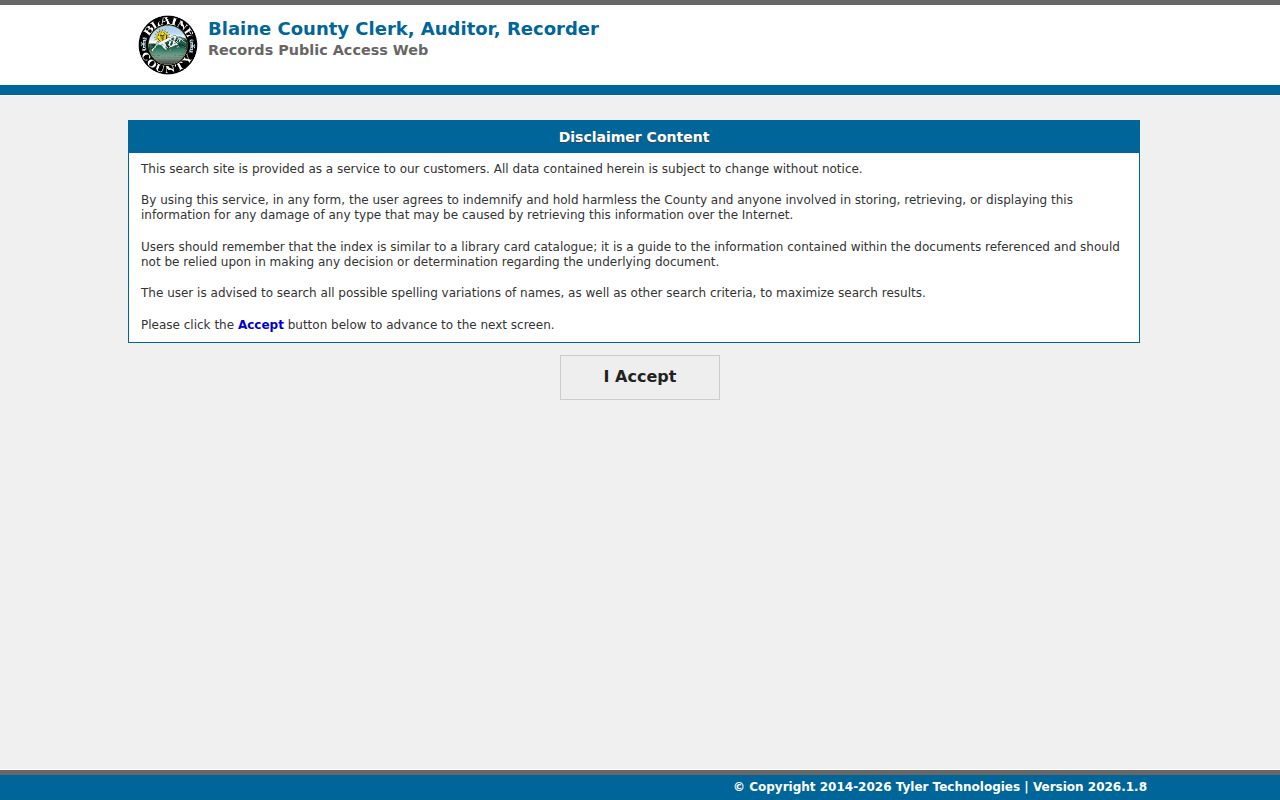
Accepting the gate grants portal access. It does not turn an index entry into a certified instrument or a title opinion.
Search Blaine Deeds with the Recorded Legal Text
Land fields narrow the match when names are common or have changed. Search parcel number, subdivision, lot, block, tract, and Notes. Then compare the legal description on the result with the current parcel card.
For a trust or entity, try exact names. Test variants on both sides of the transfer. A deed may cite an earlier plat, survey, easement, or instrument, so follow those references rather than assuming today's parcel number runs through the whole historic chain.
Blaine Court Files Can Explain a Deed
A deed chain can branch. Probate, foreclosure, quiet title, partition, a judgment, or another court order can all redirect ownership. Search Idaho iCourt by party or case number. Turn to the older Repository when the statewide portal lacks the matter. Blaine County court staff want the exact case number, party names, document title, and date. They will not run a broad search for a requester.
A docket entry shows a filing, not an outcome. Pull the judgment or order. Then return to the Recorder. Ask there for the personal-representative deed, trustee deed, release, or satisfaction that resulted. This two-source check keeps a filed claim from being mistaken for a completed transfer.
Fraud Guard Watches Names, Not Parcels
Fraud Guard watches names, not parcels. The alert service can notify you when a document enters the index under a registered name. It cannot block a recording or remove a document. Nor does it verify whether a filing is fraudulent. Register the spelling variants that matter and take any alert to the Recorder.
The service helps after a purchase or estate transfer. It cannot replace periodic review of the parcel card and the newest recorded instrument. A name-based alert may also miss a filing indexed under an entity or trust variant.
Blaine Deed References Create Useful Breadcrumbs
Copy every instrument number, recording date, and book/page citation exactly as it appears in the deed records. Exact references let Recorder staff pull a document even when a name is misspelled or the street address has changed. A cited plat, survey, easement, release, or prior deed may also explain why the current legal description looks different from older ones. That breadcrumb trail matters.
Search people and entities alike. One interest can surface under an individual, trustee, trust, company, estate, or personal representative at different points in the chain of title. A similar name alone proves nothing. Match the land description and the recording references before you connect any two results.
Recorded Claims Need a Later Blaine Release Check
Deeds rarely travel alone. Mortgages, deeds of trust, judgment liens, mechanic's liens, lis pendens, easements, covenants, assignments, and foreclosure notices all get indexed beside them. They sit together in the property records. A hit only shows an instrument was recorded. It does not confirm the claim is still active or that it holds priority.
Record the instrument number, recording date, parties, legal description, and any linked release or satisfaction. Search the lender, trustee, and claimant names too. A later release may be indexed under a different party than the owner of record. A court dispute may be behind the filing. Match the case number and get the disposition.
Exceptions, partial releases, and unrecorded interests can call for a title professional or an attorney. The Recorder will supply the indexed instrument and a certified copy. It does not issue title opinions.
Historic Blaine Sources Support, but Do Not Replace, Deeds
Old newspapers, photographs, and maps can hand you names and places. These details can restart a stalled chain of title. The Idaho State Archives reports extensive county, legal, administrative, and microfilm holdings. Its catalog also lists the 1930 History of Alturas and Blaine Counties as a research-room special collection. Treat these as context, never as a current title index.
Hailey's historic survey earns special praise. Its inventory ties together five details. It lists the property name, street address, legal description, tax parcel, and block or lot in one place. Sanborn maps add period building footprints, materials, uses, street names, lot lines, and utility context. A changed address or footprint is a clue, not proof. Use it to guide a search through permits, plats, and deed records. Do not assume a conveyance occurred.
Newspaper notices can point to a probate or tax sale. They may also flag a subdivision, street change, or business tied to the site. Confirm each event in the court order, city approval, recorded plat, or deed that legally documents it. Your chain may hit the 1985 computer cutoff. Bring Recorder or Archives staff every name, date, book/page, instrument number, and legal description you have already gathered.
Blaine County's predecessor history makes this caution essential. The county formed in 1895. A record created before that date may sit under Alturas, Logan, or Alta in the catalog. Ask staff where the relevant volume is held. An empty Tyler query never proves the transfer went unrecorded.
Order a Blaine County Deed Copy
The Blaine County Recorder sits at 206 S First Ave, Suite 200, in Hailey. It accepts submissions Monday through Friday from 9 a.m. to 4 p.m. Tyler lists electronic copies at $1 per page plus a card service fee. Certified copies cost more. Online subscriptions run $6 for one hour. They cost $20 for 24 hours, $100 for one week, $300 for one month, and $2,500 for one year.
Give the office the instrument number, recording date, party names, document type, and book/page citation when you can. A precise request speeds everything up. For extensive research reaching into the older books, the Recorder recommends a local title company or abstractor instead.
Recorded, not guaranteed. Blaine County deed records show indexed instruments, but they do not resolve priority, unrecorded interests, or clear title. The document image, not the index summary, controls.