
Trace Blaine County Former Owners
A backward deed chain starts with the newest instrument and treats each grantor as a clue. That name becomes your next search as a prior grantee. Blaine County also has several distinct record thresholds. A vague phrase like "online since" misleads. Computer entry, scanned images, microfiche, and bound books overlap. Each begins at a different point.
| Transfer Date | Grantor to Grantee | Deed Type | Book/Page or Instrument |
|---|---|---|---|
| Newest first | Current grantor to current grantee | Copy exact indexed type | Save direct reference |
| Prior transfer | Prior owner to later owner | Warranty, quitclaim, or other verified type | Follow cited book/page or instrument |
| Branch event | Estate, trust, correction, or replat parties | Copy indexed wording | Search every cited instrument |
| Older segment | Names from reverse index or deed book | As printed in book | Preserve volume and page |
Treat this table as a working timeline rather than a claim about a real transfer. Fill each row only after inspecting an actual record. The legal description keeps the chain continuous. It holds up even when a parcel number or street name changed. A book/page or instrument reference keeps your work auditable even when spellings shift.
Reconstruct Blaine's Deed Chain
The Blaine County Tyler search offers Grantor, Grantee, Both Names, recording date, instrument number, book, page, parcel, and legal-description fields. It covers several search paths. Start there with a current parcel and its owner of record. On each deed, the grantee received the interest. The grantor is your candidate former owner and points to the next link back.
- Find the newest deed by searching the current owner as grantee, then match parcel and legal description.
- Copy its grantor, grantee, recording date, instrument number, book/page, deed type, and referenced instruments.
- Search that grantor as an earlier grantee, using date and land fields to separate same-name results.
- Repeat to the computer-index boundary, then continue through microfiche, vault books, and archival sources.
- Grantor
- The party transferring an interest in the deed.
- Grantee
- The party receiving the interest.
- Chain of title
- The ordered sequence of instruments affecting ownership.
- Reverse index
- An index route that traces a name in the role needed to step backward.
- Quitclaim versus warranty
- Different deed forms whose legal effect must be read from the instrument, not assumed from an index line.
Blaine's Online Ownership Cutoffs
The Recorder's computer-entered index begins with instrument 259334 on January 2, 1985. Scanned images in the database start later, at instrument 405570 on August 29, 1997. A separate scanning project began April 23, 2001 at instrument 450331. These are different systems, so resist boiling them down to a single start year.
A February 2025 platform announcement says indexes are free online. Watermarked images need a subscription, and certified copies cost extra. Tyler itself cautions that its index works like a library card catalog. It is not the underlying instrument. Save each result, then inspect the deed before adding any former owner to your timeline.
The Recorder's online search form is the starting point for this work.
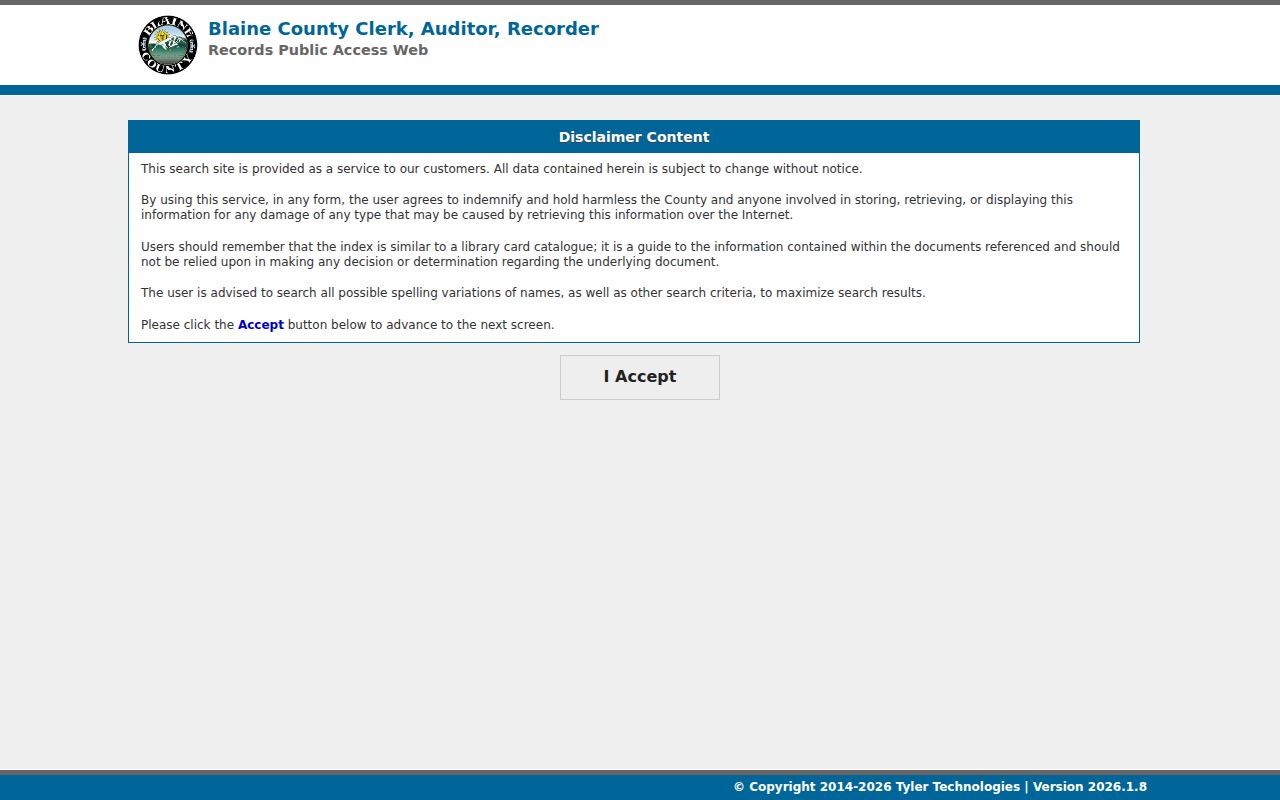
The live portal carries the current search controls, so keep exact terms and references from every result you open.
Continue Blaine Owners Onsite
Pre-1970 books and earlier indexes live onsite at the Recorder. Microfiche covers January 1970 through instrument 476210. A chain crossing those cutoffs calls for the office. A local title company or abstractor can help. Another verified archival route may also work. The Recorder sits at 206 S First Ave, Suite 200, Hailey. Submissions are accepted Monday through Friday from 9 a.m. to 4 p.m.
The Idaho State Archives preserves many county court, legal, and administrative records. The collection spans roughly 40,000 microfilm rolls. Appointments and reproduction rules apply. Archives can supply older context. But a historical index or newspaper notice is only a lead. Confirm the transfer itself in the deed book or recorded instrument.
Online depth has limits. Computer indexing begins in 1985. Earlier former owners may require microfiche, onsite indexes, deed books, or archival research.
Follow Blaine Legal Description Changes
A subdivision, replat, lot split, line adjustment, merger, annexation, or vacated plat can snap a search. This happens when it is built only on today's parcel number. When an instrument cites a plat or correction, branch the chain. Search both the old and new lot, block, unit, tract, and instrument references. Then return to the deed sequence.
For legal descriptions recorded before September 23, 2024, Tyler tells searchers to use Notes and Advanced Name Searching. Later records rely on separate subdivision and public-land-survey fields. Preserve the old wording exactly. Simplify it too soon and you risk losing the one clue that joins two chain segments.
Note: A street address starts the search. The legal description is the stronger link across older Blaine County records.
Trace Blaine Estate Transfers
A tidy buyer-to-seller sequence can break at a probate, trust, survivorship event, or correction. Search Idaho iCourt by decedent, estate, personal representative, and successor names. Older matters may still sit in the Repository. Then find the recorded instrument that moved the land. It may be a personal-representative deed or another documented estate transfer.
A court docket proves a case existed. It does not prove title changed. Obtain the order, then recheck the Recorder for the instrument tied to the parcel. Death records fall under separate state confidentiality rules. They are not handed over simply because someone is researching land.
Search Blaine's Predecessor Counties
Blaine County was created March 5, 1895. The chain before it included Alturas County, organized in 1864, Logan County in 1889, and Alta County in 1891. So a deed from around 1900 may survive even when Tyler returns nothing. County boundary history explains why an older record can sit under a predecessor's name.
The courthouse dates to 1884. No courthouse fire or countywide reindexing disaster is on record. So a missing result deserves no such excuse. Ask Recorder or Archives staff where the predecessor-county deed books are held. Search former subdivision names and old book/page references, not just the current location.
Test Blaine Historic Record Leads
Historic plats, Sanborn maps, photos, and newspapers can explain an old street name, an early business use, or a subdivision event. Hailey's historic survey stands out. It preserves street address, tax parcel, legal description, and block or lot fields. That bridges an old name to today's assessor parcel.
These sources add no former owner alone. A Sanborn map cannot prove a present boundary, either. A newspaper notice records intent, not a completed transfer of the parcel. Treat each find as a lead. Use it to locate the matching deed, plat, survey, or court order in Blaine County property records. The recorded chain stays the backbone.
The Idaho State Archives lists early Ketchum newspaper runs, and local history collections cover Wood River Valley places and people. Search sale, probate, subdivision, and business notices for a name or date lead. Then return to the official index and book reference.
How Far Blaine Ownership Goes
Blaine County chains run deeper than the 1985 computer index. The route runs through vault books, microfiche, plats, and predecessor-county references. No single earliest year describes the whole image set. Images start later than the computer index does. The oldest Blaine County deed may take onsite work at the recorder's vault.
Write down the point where the evidence stops. A miss can mean many things. Spelling could explain it. A changed legal description, an index cutoff, a trust or estate name, or a predecessor jurisdiction could too. None of it proves the chain ends there. Ownership today is a separate question. The Blaine County current owner page keeps that snapshot distinct from the chain back.
For deep chains, the Recorder recommends a local title company or abstractor. That matters most across the computer-index boundary. Bring the last confirmed instrument, its legal description, and every branch reference. That gives a firm start in the microfiche or vault books. It also skips the online stretch already covered.
Lawful use. Research prior owners for house history, estate work, or property diligence. Never use the record trail to track, harass, or harm a living person.